nanoru


Your form works with your test data. Does it work with your customers’ names?
nanoru helps people building Japanese websites find forms that reject or change someone’s name. Claude tests different name formats in a real browser. The report shows what was entered, what the form kept, and where the journey stopped.
On one public Tokyo reservation form, five of six cases reached confirmation. A 28-character sample name was rejected. After a repair on a local reproduction, all six reached confirmation. The public website was unchanged.
Built with Claude Code for Built with Claude: Japan 2026.
Watch the demo (2:52) · View sample results (recorded run, read-only) · Repair before / after · Run locally · How Claude works
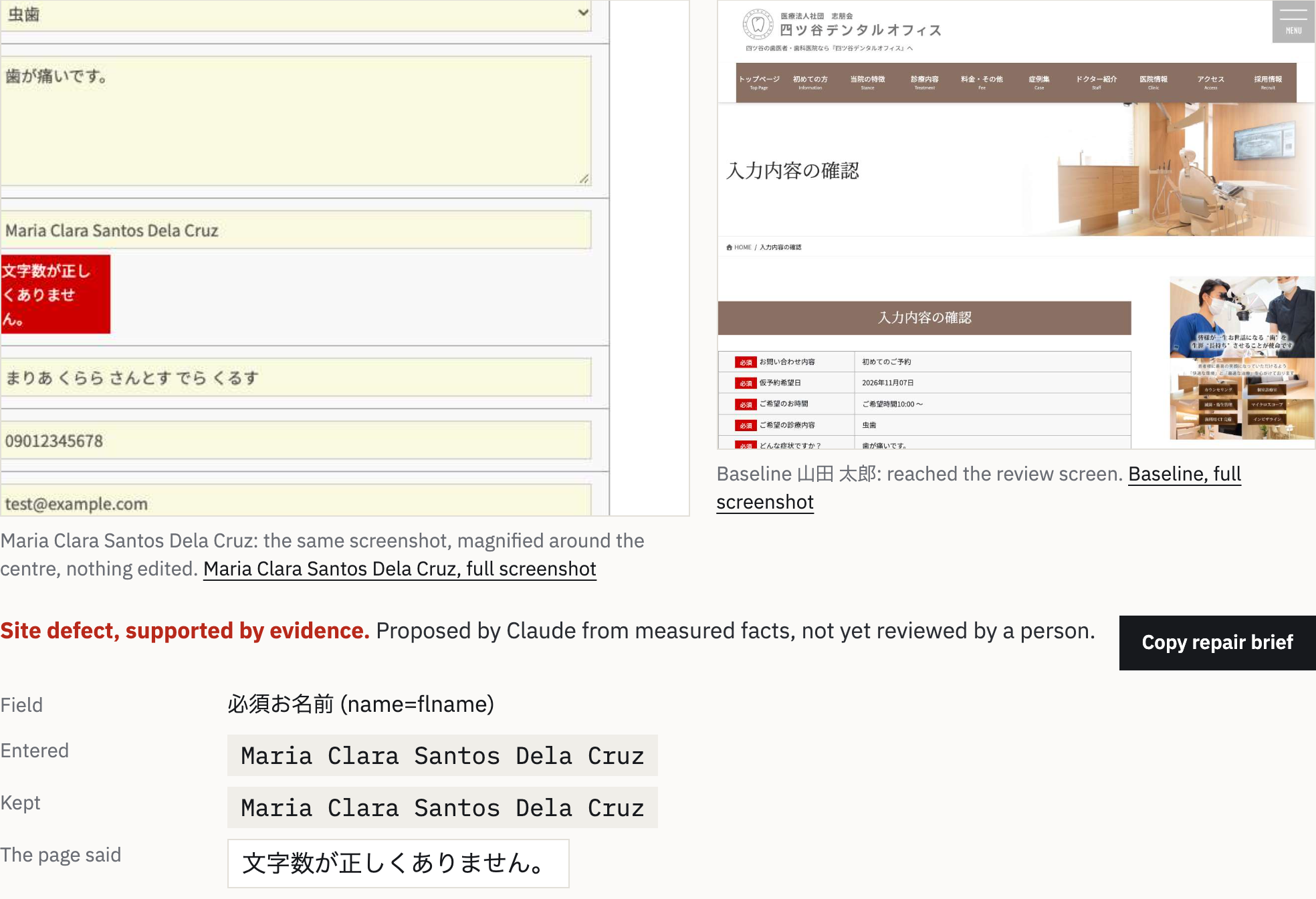
Detail from the recorded public run: the 28-character sample name kept in the field, the form’s error beside it, and the kanji-name baseline on the confirmation screen. Full report. Sample inputs, a local repair, a review screen reached, never a completed booking.
Who it is for
Developers, designers, and people building Japanese sites with AI, who want to know before release whether a form works for names that are not kanji-plus-kana.
What happens in a run
- A kanji-name baseline fills the form and reaches the review screen.
- The same form is run again with name-format test cases. The agent is told to keep every non-name choice the same; the report then compares the non-name rows of each confirmation screen with the baseline’s and says whether they matched (measured), rather than assuming it.
- Measurements are code: what each field kept, what the page said, whether the review screen was reached and shows the name exactly.
- Claude writes the finding from those measurements and proposes a repair.
- You repair your own form (or a local reproduction), and the same cases rerun.
What it found on a real form
A public dental reservation form in Tokyo (runs/yotsuya-dental-*): the Japanese baseline and four of five test names reach the confirmation screen. The 28-character test name “Maria Clara Santos Dela Cruz” is rejected with 「文字数が正しくありません。」 (character count incorrect). The limit is not in the page source, so nanoru measured it: with every other field identical, 20 characters are accepted and 21 are rejected (runs/yotsuya-dental-1/diag/). The server implementation was not inspected. A labelled local reproduction of that form, repaired by raising the limit (the required check is kept), passes all six cases on rerun. The live site is unchanged.
A second public form, a hotel’s accommodation inquiry page (runs/imperial-hotel-2), shows a different failure: nothing is rejected. The accented test name “Nguyễn Thị Hương” is accepted at entry, and the confirmation screen then displays it as Nguyễn Thị Hương, literal character codes where the accented letters should be. The baseline’s row is shown correctly, and the non-name rows on the confirmation screen match the baseline’s, row for row (measured). nanoru’s checkpoint check measured the changed row (outcome “reached, name shown changed”), and Claude’s proposed cause is double escaping, reproduced from the displayed text and not confirmed in source. Report: imperial-hotel-2/report.html. An earlier pair, runs/imperial-hotel-1, shows the same corruption but its two runs differed in an optional check-in date, which its report now says; it is kept as recorded. No inquiry was sent and no repair was attempted; the form is not ours.
Across a 32-form sample of public Tokyo forms (both sites above are in it), a model-free probe (nanoru scan) flagged a handful of further observations pending review (a hiragana field rejecting a long-vowel mark, a parent-name field converting Latin letters to full width and capping at five characters). Those are observations, not proven exclusions; see runs/scan-tokyo-1/scan.html for the honest categories. The hotel lead came from that scan and was then confirmed with a full run.
Why name handling matters
Documented context, not nanoru test results:
- PayPay states that bank-account linking can fail when the registered name differs from identity-verification information, and that unnecessary spaces can stop the next button from working. https://paypay.ne.jp/help/c0147/
- PayPay’s identity verification has special instructions for middle names and single names (middle names in the given-name box, single names split across two boxes). A supported path exists, but it has to be found. https://paypay.ne.jp/help/c0422/
- PayPay Card tells applicants with long names to omit middle names or trailing parts to fit ten characters per name field. https://www.paypay-card.co.jp/service/004549.html
- GovTech Tokyo’s Input Form Guidance ver 1.1 (March 2026), page 27, asks for one full-name field that fits middle and compound names, acceptance of the scripts people write their names in, spaces allowed, and a sufficient maximum length “because foreign names need more characters”. It is guidance for Tokyo Metropolitan Government forms, not a law. https://www.digitalservice.metro.tokyo.lg.jp/documents/d/digitalservice/inputform_guidance_v11
4,281,026 foreign residents lived in Japan as of June 2026 (Immigration Services Agency). That is context for who meets these fields, not a count of people whose names fail.
Before you run it
- Node 22.12 or newer (the dependencies require it; built and tested on Node 22), Google Chrome installed (Playwright drives the real Chrome channel), an Anthropic API key. Runs make paid API calls: roughly 10 to 20 model calls per name case for navigation (Claude Sonnet) plus one diagnosis call (Claude Opus).
- Data flow: the browser runs on your machine, but each step sends a screenshot and the page’s visible text and element list to the Claude API, and the diagnosis step sends the measured facts. Run artifacts (screenshots, report.json, report.html) are saved locally under
runs/. Nothing is uploaded anywhere else. - Safety: nanoru is built to stop at the review screen. Known final actions (送信, 確定, 申込, 予約する, Send, Submit, Register, Book now, Pay, and their accessible labels) are blocked in code (
src/guard.ts, tested). That is a word list plus accessible-name matching, not a proof: on an unfamiliar site a control labelled “Next” could still submit, so treat the first run on any new site as something to watch, and prefer forms you own. The demonstrated runs did not complete a booking; the send button was never clicked.
Quick start on the bundled fixture (recommended first run)
npm install
npx playwright install chrome
cp .env.example .env        # put your ANTHROPIC_API_KEY in .env (gitignored)
npm run build
Terminal 1, the local test form (a clinic reservation form with three deliberate name rules):
npm run fixture
Terminal 2, nanoru:
node dist/cli.js run http://localhost:4310/ "reach the reservation review screen"
Then open the path it prints (runs/<id>/report.html). Expect two names cut by a 10-character limit, one katakana reading rejected for its space, and one single-name case stopped by a required given-name field.
A finance-style example, simulated locally
Financial services publish name-entry limits too. PayPay Card’s help tells applicants with long names to omit middle names or trailing parts so that each name field fits 10 characters, and each kana field 15 (https://www.paypay-card.co.jp/service/004549.html, read 2026-11-08). The help does not say whether the real form rejects or cuts the input, and nanoru has not tested PayPay or any bank.
fixtures/card-apply/ is a small fictional card-application name step built on those published limits, with a banner that says so on the page and on its report. Its error behaviour (reject and keep the typed value) is our implementation. fixtures/card-apply-repaired/ raises both limits to 100 characters, a fixture choice, not a banking standard; required-field checks and output escaping are unchanged.
Reports: card-local-before and card-local-after. What they show is that nanoru measures the simulated limit on the given-name field for “Maria Clara Santos Dela Cruz” (given name 18 characters), and that the same name reaches confirmation intact on the repaired copy. They do not show anything about a real provider.
To reproduce (two more terminals for the two fixture states; the run ids below are new on purpose, nanoru refuses to write into an existing run folder, so the bundled evidence stays as recorded):
NANORU_FIXTURE_DIR=fixtures/card-apply NANORU_FIXTURE_PORT=4314 node dist/fixture-server.js
NANORU_FIXTURE_DIR=fixtures/card-apply-repaired NANORU_FIXTURE_PORT=4315 node dist/fixture-server.js
node dist/cli.js run http://localhost:4314/ "reach the confirmation screen" --cases long-name-spaces --local --run-id card-example-before --simulation "Local finance simulation inspired by published name-entry limits. Not a test of PayPay or a bank. No application is submitted."
node dist/cli.js run http://localhost:4315/ "reach the confirmation screen" --cases long-name-spaces --local --repaired --before card-example-before --run-id card-example-after --simulation "Local finance simulation inspired by published name-entry limits. Not a test of PayPay or a bank. No application is submitted."
Running on other forms
# Full run: baseline + name cases, Claude drives the browser, report in runs/<id>/report.html
node dist/cli.js run https://example.jp/reserve "reach the confirmation screen"

# Only some cases, visible browser, higher step budget
node dist/cli.js run <url> "<goal>" --cases long-name-spaces,single-name --max-steps 40

# Rerun a saved run against a repaired local copy. The target is explicit on purpose.
node dist/cli.js rerun <run-id> --target http://localhost:4313/

# Probe many forms' name fields with no model in the loop (nothing submitted)
node dist/cli.js scan scan/tokyo-forms.txt --headless

# List the name-format test cases
node dist/cli.js cases
How Claude works, and what is code
- Baseline: a Japanese name (kanji with its reading), Tokyo address, Japanese mobile, plain email. Claude (Sonnet) reads each page as an accessibility snapshot plus a screenshot, returns one action at a time through a strict
acttool, and stops at the goal screen. It is built to stop at the review screen; known final actions are blocked in code (see Before you run it), and uncertain flows stop for review. - Name cases: same form, same contact details, the same fixed non-name choices as instructions to the agent; whether they were in fact the same is measured afterwards on the confirmation screen and stated on the report. Reading fields get the script they ask for (hiragana for ふりがな, katakana for フリガナ); nanoru never substitutes the other script to get past an error.
- Measurement is code (
src/checks, unit-tested): after every fill, the field’s retained value, native validation message, aria-invalid and visible error text; after a failed confirm click, every invalid field re-read by name/id; at the goal screen, whether each typed value is shown in full, cut, HTML-escaped, or missing. Errors already on screen before a fill are treated as stale. - Diagnosis: Claude (Opus) writes each finding from those measured facts only, with the Tokyo guidance text loaded from the
jp-form-checksSkill, as structured output. Four classes: site defect supported by evidence, agent limitation, no observed issue, inconclusive. Every finding is marked “proposed, not yet reviewed”. - Report:
report.html(verdict, comparison, selected finding with paired screenshots, before/after when it is a rerun, collapsed action log) andreport.json.
Run outcomes are: reached the review screen (verified: typed values shown on it), reached it with the name shown changed (the screen was recognised but a typed name is displayed differently in its row), stopped before it (a measured rejection), not determined (step budget, no progress, or a safe stop that could not be verified). “Reached with a workaround” exists as a label but nanoru does not attempt alternate entry paths yet; where a page documents one, the finding says so.
What nanoru will not claim
- No national failure rate. The scan is our sample, probe only, with its uncounted categories listed.
- Guidance, not law: “inconsistent with the guidance”.
- “Reached the confirmation screen”, never “completed a booking”. Nothing is submitted.
- A required reading field is not a defect. A rejected reading is a defect only in the script the field asked for, with no documented alternative.
- Names in the battery are name-format test cases, not verified legal identities. A long-name limit affects people of any nationality.
- A repair verified on a local reproduction verifies the reproduction, not the live site.
How Claude was used
Everything in this repo was written with Claude Code during the event. CLAUDE_USAGE.md is the log, kept as it happened. In the product: Claude Sonnet drives the browser; Claude Opus diagnoses and proposes repairs; the jp-form-checks Skill carries the check semantics and the guidance text into diagnosis; a PostToolUse hook (.claude/settings.json, scripts/rerun-on-edit.sh) reruns the saved run when a file under local/ is edited, with path filter, debounce and recursion guard. Measurement never depends on a model.
Layout
src/agent/      browser loop (loop.ts) and page snapshot/observation helpers (page.ts)
src/checks/     pure measurement functions, tested
src/battery.ts  baseline identity, name-format test cases, fixed scenario
src/diagnose.ts Opus writes findings from measured facts
src/report/     HTML report
src/scan.ts     model-free name-field probe across many forms
src/verdict.ts  the one honest sentence at the top of a report
fixtures/       local clinic form with deliberate name rules; card-apply and card-apply-repaired, the finance simulation
local/          labelled local reproductions (before / repaired)
runs/           saved runs: screenshots, report.html, report.json (gitignored except examples)
scripts/        boundary probe, rerender, hook
.claude/skills/jp-form-checks/SKILL.md
Limits and future work
- One site at a time, sequential cases. Parallel subagents were not needed for the demo and were left out.
- The review-screen check matches a typed name value against any name-labelled review row. It does not yet bind each input to its own row, so a name and a reading swapped between the name and reading rows would both still count as shown. The headline evidence is unaffected (its rows hold the right values), but no general row-specific preservation guarantee is claimed.
- The scan (
nanoru scan) is a probe for forms you have reason to test; it is not an onboarding path. Prefer your own forms or the fixture first. - The scan stalls on forms whose other required fields it cannot fill (dates, consent); those are reported as incomplete, not as results.
- Provider-specific name rules (payment and identity verification flows) and downstream name preservation are future work, to be tested only in an authorised provider environment.
- Alternate entry paths (documented workarounds) are reported, not attempted.
MIT (see LICENSE). Screenshots under runs/ are third-party page evidence; see EVIDENCE_NOTICE.md.